
Home > Operating Model > Prosable Operations Engine
― Prosable Operations Engine
Four Components, One Operating Layer
Most workflows launch with the automation working and everything else undefined. Business rules live in someone’s head. The platform runs unmonitored. Exceptions route to whoever happens to be available.
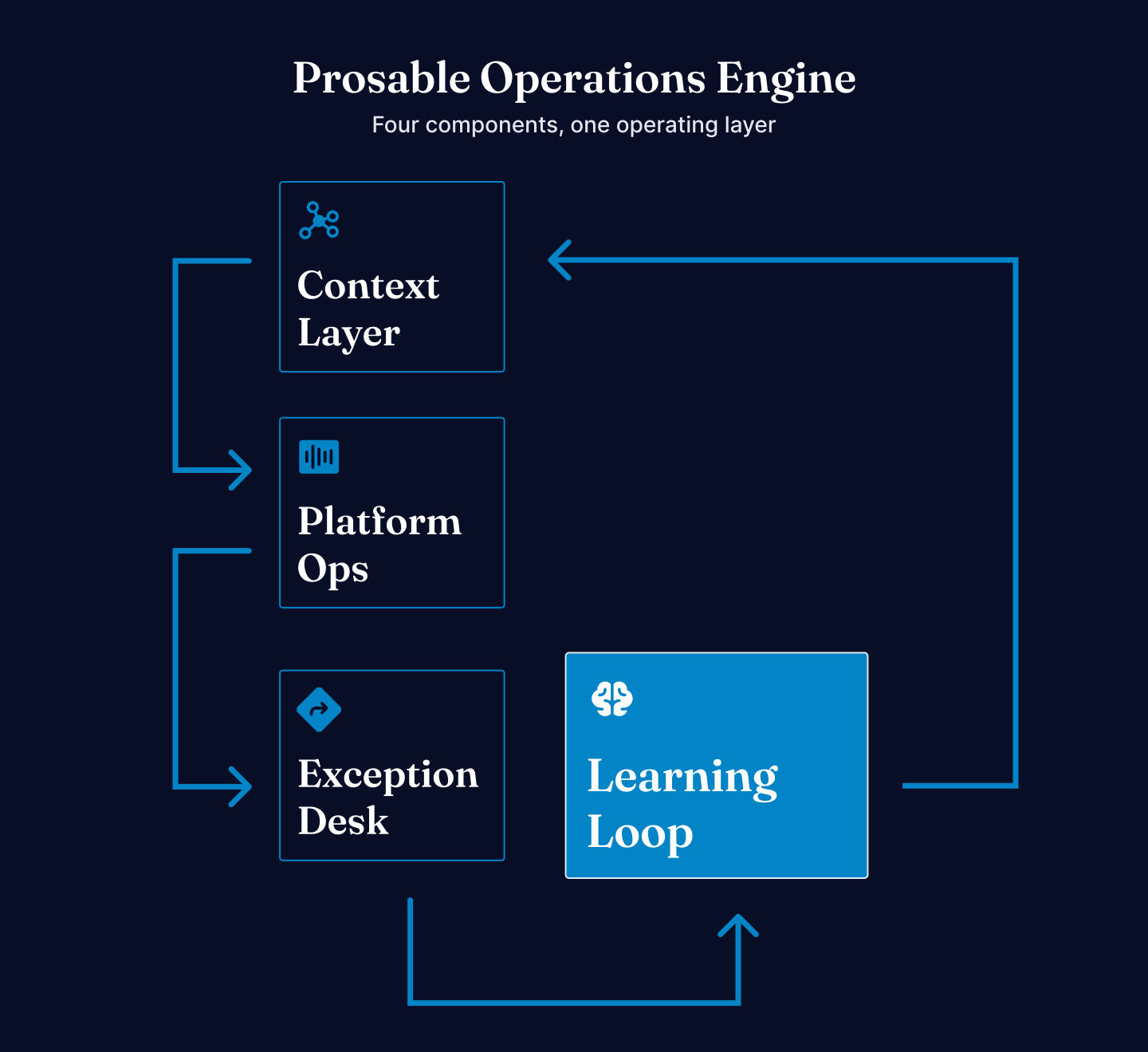
The Prosable Operations Engine is the operating layer that fills those gaps. It has four parts: Context Layer, Platform Ops, Exception Desk, and Learning Loop. The Engine works as one system: each component’s output is the next component’s input.
Context Layer
Most exceptions trace back to missing context, not to failing models.
An accounts payable workflow rejects a legitimate invoice because the vendor’s payment terms changed in the last contract renewal and nobody updated the matching rules. A customer service agent applies the wrong return policy because the regional exceptions were never encoded. An escalation routes to a team that no longer owns the product because the org restructured and the routing rules still reflect the old structure. These are context failures, not model failures, and they are the single largest source of avoidable exception volume.
The Context Layer encodes what the workflow needs to behave correctly: business rules, policy interpretation, escalation paths, approval thresholds, and domain-specific knowledge that determines routing and resolution. With this layer in place, the workflow applies the right rules consistently rather than relying on individual judgment at every step. The Context Layer catches incomplete or conflicting inputs early, before they become exceptions that consume the Desk.
Platform Ops
The workflow that passed every test in pilot can still break under production load, and the failures look like AI problems even when they are infrastructure problems.
Model drift changes outputs gradually. By the time exception rates spike on a marketing lead-scoring workflow, the training data has been stale for weeks. A CRM vendor pushes a breaking API change on a Friday afternoon and the sales pipeline stops syncing. An upstream system pushes a schema change that reformats quantity fields, and the procurement workflow starts rejecting valid purchase orders because the parser expects the old structure. These are not edge cases. They are the normal operating environment for any workflow connected to live systems, and if nobody is watching, each one generates exceptions that mask the root cause.
Platform Ops keeps the technical layer reliable under production conditions: monitoring, alerting, performance tracking, integration management, system health, and the logging infrastructure that captures AI inputs and outputs. That data store feeds the Learning Loop and serves as the foundation of the operation’s audit trail. The goal is not just uptime. It is catching technical drift before it hits the exception queue, so the Exception Desk handles business exceptions, not infrastructure failures disguised as business exceptions.
Exception Desk
Exception volume scales with throughput even when accuracy improves.
- 90% accuracy × 1,000 executions = 100 exceptions
- 95% accuracy × 10,000 executions = 500 exceptions
That math is why exception handling cannot be an afterthought. As the Why AI Workflows Stall analysis shows, the team that absorbed exceptions through extra effort at pilot scale hits a wall when production volume arrives.
The Exception Desk resolves that work through tiered routing. L1 AI workers classify and resolve routine exceptions inside documented rules. L2 human specialists handle judgment calls that require context, policy interpretation, and domain expertise. L3 domain experts handle high-stakes decisions and process redesign. The structure keeps routine volume moving while reserving human judgment for the cases that need it, and the tiers are calibrated so each case reaches the right level of capability, not just the next available person.
Learning Loop
An operation that resolves exceptions but never learns from them is just expensive triage.
Every operation generates signals: recurring exceptions, performance trends, backlog behavior, resolution times. The Learning Loop captures these patterns and the feedback from the people handling the work, drawing on the prompt and output records that Platform Ops maintains. Those records tell the team what to retrain, retune, or redesign. For compliance purposes, the EU AI Act (Article 12) and emerging U.S. federal guidance now treat AI inputs and outputs as records that enterprises must retain and produce on request, making the logging infrastructure a regulatory requirement as much as an operational one.
These patterns feed back into the workflow, playbooks, and operating rules through weekly exception reviews that surface what is new and recurring, monthly playbook updates that codify what the team has learned, and quarterly process reviews that redesign areas where friction keeps showing up.
The economic consequence is direct. Each cycle reduces the share of exceptions that require human involvement and increases the share the system handles on its own. The operation gets less expensive per unit of throughput as it matures, not more.
The Connections Matter More Than the Parts
Each component depends on the others, and the failure mode is predictable when a piece is missing. Without business context, the Exception Desk drowns in avoidable cases that never should have reached the queue. Without the Exception Desk capturing resolution patterns, the Learning Loop has nothing to learn from. Without the Learning Loop rewriting rules, the Context Layer stays static and the same exceptions keep recurring. Without platform stability, all three produce unreliable data.
When the Exception Desk sees a cluster of invoice-matching failures caused by a vendor payment-term change that was never reflected in the business rules, that pattern feeds the Learning Loop. The Loop updates the matching rules. The Context Layer encodes the new terms. The next occurrence clears at L1. That cycle is how the Engine reduces what reaches the queue, not just how it handles what is already there.
